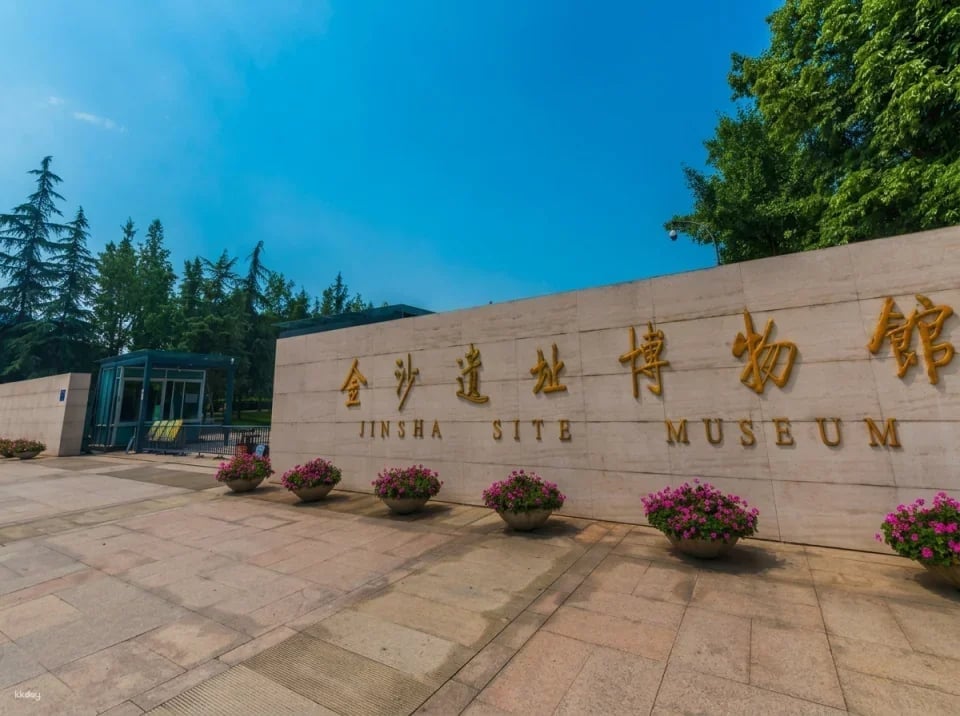
Highlights
- Explore the Jinsha Site Museum and witness national treasures like the Sun Bird Gold Ornament, an official symbol of Chinese cultural heritage.
- Walk on a glass walkway to see sacrificial pits from 3,000 years ago and marvel at the abundance of ancient ivory below.
- Discover the golden mask, a top-tier artifact used by ancient Shu kings in sacrificial rites, rivaling Sanxingdui artifacts.
- Visit the ten-section jade cong, which traveled from Liangzhu in Zhejiang to Chengdu, revealing stories of ancestral communication.
- Relax in the Ebony Forest and Deer Park after exploring cultural relics, perfect for therapeutic photo opportunities with adorable deer.
Your Experience
The Sun Bird Gold Ornament – a national treasure among national treasures! Made of ultra-thin gold foil at 0.02 cm, featuring four birds circling the sun, it embodies the aesthetics of the ancient Shu people and is also an official symbol of Chinese cultural heritage.
Archaeological Experience
The site visit to the archaeological site has been transformed into an exhibition hall. Walking on the glass walkway allows you to see the sacrificial pits from 3,000 years ago and the abundance of ivory below, creating an incredibly awe-inspiring experience.
Artifacts and Craftsmanship
The golden mask—a top-tier artifact used by the ancient Shu kings in sacrificial rites—is so exquisitely crafted that it rivals the Sanxingdui artifacts. A close look reveals a level of artistry that prompts exclamations like, "Is this craftsmanship truly top-notch?" The ten-section jade cong—which "wandered" all the way from Liangzhu in Zhejiang to Chengdu—proves that our ancestors were communicating thousands of years ago, and it has a very interesting story.
Relaxation Areas
Ebony Forest + Deer Park – The thousand-year-old ebony is perfect for taking photos, and the adorable deer can be quite therapeutic. It's the perfect place to relax after visiting the cultural relics.
Cultural Immersion
Visiting the Jinsha Site is like stepping directly into the ancient Shu Kingdom of 3,000 years ago, witnessing firsthand the rise and fall of a mysterious civilization. See national treasures here, including the "Sun Bird" gold ornament, a symbol of Chinese cultural heritage. Its exquisite craftsmanship makes it hard to believe it's a product from three thousand years ago.
Missing it is like not understanding the ancient Shu civilization. The museum is built directly on the archaeological pit. Standing on the glass walkway and looking down, you can see the sacrificial area and mountains of ivory at your feet. The shock of "history is right in front of you" is a hundred times stronger than reading a textbook.
Complete the puzzle of Sanxingdui: If Sanxingdui is its mysterious and extravagant origin, then Jinsha is its final, glorious chapter after its maturation and migration. Only after visiting will you truly understand the origins and development of the ancient Shu civilization. Simply put: This isn't a cold, impersonal museum, but a park that lets you "step directly into history." It features national treasures, live exhibits, and compelling stories, making for a relaxing yet awe-inspiring visit—it would be a real shame to miss it.
Cancellation Policy
These tickets can't be rescheduled or cancelled.